Download and read more about sIfA here
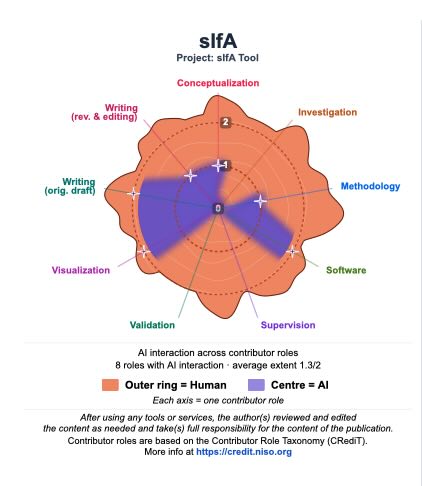
The sIfA Too helps to reflect on and declare how humans and AI interacted in a knowledge creation or creative process. It emphasises that we can only learn how interaction with AI is influencing these processes ifwe reflect on AI interaction at each step of a process.
sIfA gives researchers a structured, standardised way to record AI interaction across every stage of a research project, anchored in the Contributor Role Taxonomy (CRediT) that researchers and publishers of research already understand. If CRediT does not apply to your processes, you can use your own process and develop your own taxonomy.
What sIfA is
AI interactions in knowledge creation are expanding faster than conventions for declaring it can keep up. Free-text disclosures are inconsistent and difficult to compare. sIfA — Statement of Intellectual Fellowship and Accountability — gives authors and knowledge creators a shared, structured format for disclosure.
With the sIfA tool you map your AI interaction onto the 14 CRediT contributor roles — the standard that most major journals already use to record who did what. For each role, you record for what type of work AI was used and which AI tool, how extensively (on a simple three point scale: not at all, little, a lot), and a short audit-trail note. The result is a table and a distinctive figure you can attach to any publication, report, or institutional disclosure form. The sIfA figure reflects a commitment to reflection and transparency when it comes to AI in knowledge creation; the table acts as a detailed track record that supports learning for all.
sIfA means ‘the quality of something’ in Arabic and Swahili but also stands for Statement of Intellectual Fellowship and Accountability. The use of the word fellowship to describe AI interaction reflects what advanced work with AI can be: it can be a friendly, supportive and challenging interaction, if used responsibly, reflectively and transparently. "Accountability" keeps responsibility for conducting the work and managing the interaction with AI with the human author, who is making the disclosure deliberately and transparently.
How to cite sIfA
Cite the tool:
Schomerus, Mareike. sIfA Tool (Tool to create a Statement of Intellectual Fellowship and Accountability). Version 1.4. 2026. Busara. https://doi.org/10.5281/zenodo.20285993
Cite the paper:
Saleh, Engy and Mareike Schomerus. The sIfA tool for a Statement of Intellectual Fellowship and Accountability: An invitation to reflect on how humans and AI interact in producing knowledge. (Groundwork 32 Thought Piece). Nairobi: Busara. doi: 10.62372/IUPB2137.
A machine-readable citation file (CITATION.cff) is included in the repository and powers the "Cite this repository" button on GitHub. The CRediT taxonomy itself is maintained by NISO — please cite it separately in extended documentation.